

Nationwide Code Compliance Support
Tennessee Elevator Code 2026
Regulations & Standards
Switch to Cellular Phone Lines and Save 30% or More!
Find the latest information on Tennessee Elevator Code, laws, and safety standards. Our directories are updated monthly and include website links to help you quickly find the elevator codes and regulations for the state of Tennessee (TN)
Tennessee elevator codes impose a responsibility on building owners and property managers to adhere to specific requirements within elevators, ensuring the safety of all occupants. Failure to comply with these codes can result in penalties and potential legal action. While the particulars of the STennessee elevator code may differ at the state and local levels, three primary codes govern elevator safety: the American Society of Mechanical Engineers (ASME), the International Building Code (IBC), and the Americans with Disabilities Act (ADA).
ADA
The Americans with Disabilities Act (ADA) mandates unrestricted and equal access to services for individuals with disabilities.
IBC
The International Building Code (IBC) establishes precautions against hazards associated with constructed environments.
ASME
The American Society of Mechanical Engineers (ASME) plays a pivotal role in the development of codes and standards.
The State of Tennessee (TN) currently operates under the 2016 ASME A17.1 and CSA B-44 Code
Building permits issued before July 18, 2021 use A17.1 2010, and permits issued on July 18, 2021 and after use A17.1 2016.
Tennessee Elevator Code Authority
About Elevator Unit of the Workplace Regulations & Compliance Division
The Elevator Unit inspects every device, such as passenger and freight elevators, escalators, dumbwaiters, moving walks, ski lifts, sky lifts, and aerial trams. Each device is initially inspected for compliance with code, rules, and laws adopted by the State of Tennessee to ensure they are installed properly. These devices are then inspected twice a year for the life of the device.
1. Emergency communication is required to be tested monthly. A phone test log shall be kept on site in a location viewable by the elevator inspector. The log shall contain the date of the test, the person performing the test and whether the test passed or failed.
Department of Labor and Workforce Development
220 French Landing Drive
Nashville, Tennessee 37243
2. Emergency Fire test, Phase 1 and Phase II Fire Service, shall be performed bi-annually. A Fire test log shall be kept on site in a location viewable by the elevator inspector. The log shall contain the date of the test, the person performing the test, and whether the test passed or failed. A failure of any test requires the affected component to be repaired immediately.
3. The owner or his duly authorized agent shall immediately notify the State of Tennessee Elevator Unit of each and every elevator, dumbwaiter, escalator, or other lift accident involving a person requiring the service of a physician, or damage to the elevator, dumbwaiter, escalator, or other lift equipment that impairs the safe
operation of such equipment. The equipment shall be removed from service, shall not be worked on or returned to service prior to an inspection by a State of Tennessee Licensed Elevator Inspector.
Elevator Cellular Phone Lines
How to eliminate the cost of traditional elevator phone lines and save 35% or more. Our cellular elevator phone lines conform to ASME, ADA, and IBC codes, encompassing all requirements of the Tennessee elevator code.

Please be advised that we are committed to consistently delivering accurate and current adoption information. We diligently update our records as new Tennessee elevator code information becomes available.
Tennessee Elevator Code – Elevator Phone Requirements ASME A17.1
- Two-way communication between elevator and authorized personnel
- On-site communications if over 60 ft of travel
- Communication between the elevator if elevator has remote machine room
- Answer by live authorized personnel – no automated answering
- Communication capability for onsite emergency personnel
- On-site monitoring if staffed 24/7 by authorized personnel
- Location identification on demand to authorized personnel
- Location identification without voice communication
- Hands-free devices only and telephone handsets are not allowed
- Phone automatlly answers when calling into elevator
- Automatic redirect if no answer onsite
- Monitoring the status of local telephone lines and issuing local alerts
Code Compliance Guidelines
Current adopted safety code baseline
The Tennessee Elevator Code framework is set through state rules and board-adopted standards, with a clear effective date for the currently referenced ASME A17.1 edition. If you manage elevators across multiple properties, align your compliance file to the effective dates used by the state so your inspection readiness, testing documentation, and contractor scope all match what inspectors expect.
Which code applies to your project date
Under the Tennessee Elevator Code, permit timing matters for new work and major changes. State guidance indicates older permits may follow an earlier A17.1 edition, while permits issued on and after July 18, 202,1 follow the newer adopted edition. For modernization planning, confirm the building permit date, the elevator permit application date, and the exact scope of work so your contractor’s submittal references the correct requirements.
Inspections and enforcement expectations
The Tennessee Elevator Code program relies on routine state inspections over the life of the equipment, not just at installation. Property teams should plan for inspector access, machine room and controller access, and clear visibility of required posted documents. A best practice is to keep a single “inspection readiness” binder per device that includes permits, prior inspection notes, maintenance records, and any corrective action closeouts.
Operating permits, certificates, and renewals
Staying current with the Tennessee Elevator Code also means tracking operating permits and ensuring certificates remain valid for each device. When portfolios change hands or management shifts, transfer the compliance calendar immediately so renewals do not get missed. Treat permits and certificates like life safety assets, because a lapse can create operational disruption, add administrative work, and avoidable risk exposure.
Construction permits and plan review
For new installations and many alterations, the Tennessee Elevator Code requires a construction permit before work begins, with plan documentation supporting the scope. Build extra lead time into schedules for application preparation, drawing coordination, and revisions. The fastest way to reduce delays is to submit complete, consistent information across the elevator contractor, the engineer of record when applicable, and the owner’s authorized agent.
Modernization and alteration compliance
When you modernize equipment, the Tennessee Elevator Code expects the altered system to be evaluated against applicable rules for alterations and upgrades, not simply “like-for-like” replacement. Define the modernization scope in writing and confirm whether the change triggers a special inspection, an acceptance-type inspection, or other state-required review. Clear scope language protects owners and contractors by reducing interpretation disputes later.
Licensing and qualified work performance
Because the Tennessee Elevator Code is enforced at the state level, elevator work should be performed by qualified professionals operating within the state’s licensing and inspection structure. Owners should verify contractor credentials, confirm who is responsible for coordinating inspections, and ensure a named point of contact is accountable for corrections. This reduces “handoff gaps” where no one owns the closeout steps after work is completed.
Variances, exceptions, and unique site conditions
If a site condition makes strict compliance impractical, the Tennessee Elevator Code process includes a path for requesting exceptions through the state board oversight. Variance style requests should be treated as a documented engineering and safety justification, not an informal workaround. Start early, document the constraint, propose an equivalent safety approach, and keep written approval records available for future inspections and property transitions.
Emergency communications reliability
Emergency communications are part of the Tennessee Elevator Code compliance picture because elevator passengers must be able to reach help during an emergency. Owners should treat the in-car communication device and its connectivity as a maintained life safety system, not an afterthought. That means reducing single points of failure, coordinating access for testing, and planning for carrier or building telecom changes that could interrupt connectivity.
How MyLinkLine supports compliance
MyLinkLine supports Tennessee Elevator Code compliance by replacing aging analog lines with cellular elevator phone lines designed to conform to ASME, ADA, and IBC emergency communication requirements. For multi-site portfolios, Tennessee Elevator Code readiness is easier when each elevator phone line is standardized, documented, and maintained with a consistent approach across properties, so emergency communications stay dependable during inspections and day-to-day operation.
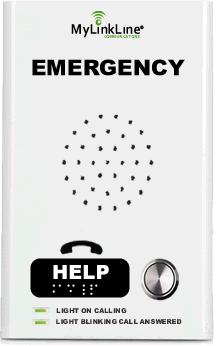
Emergency Elevator Phones
MyLinkLine will only install elevator telephones that meet code requirements. We also comply with ADA, ASME, ANSI and IBC codes in addition to all State and Local requirements if applicable. Volume pricing available.

Elevator Phone Monitoring Service
Our dispatch center has been delivering professional service for over twenty years. Our staff has extensive technical and interpersonal training to assist in emergency and non-emergency situations.

Lifetime Product Warranty
If any part of your elevator telephone(s) or elevator cellular landline fails at any time during your lifetime due to a defect in material or workmanship, we will repair or, at our option, replace the defective device at our cost***
Frequently Asked Questions
Elevator Code and Inspection Compliance
What is the Tennessee Elevator Code currently based on?
It is based on state-adopted rules that reference specific national safety standards for elevators and related conveyances. The key practical step is to identify which adopted edition applies to your device or project based on its permit date and scope of work. Your elevator contractor and property compliance file should match the state’s effective dates and any amendments or exceptions that were approved for the specific installation.
Does Tennessee apply different code editions depending on permit date?
Yes. State guidance indicates permits issued before July 18, 2021, follow A17.1 2010, while permits issued on and after July 18, 2021, follow A17.1 2016. If you are planning modernization work, confirm the permit timing early so the submittal set and inspection expectations align. This Tennessee Elevator Code detail is one of the most common sources of confusion during upgrades.
Do elevators need an operating permit or certificate to run?
Operating permits and posted certificates are a core part of compliance. Owners should keep permits current, ensure required postings are visible, and address inspection findings promptly. If ownership or management changes, transfer the renewal calendar and prior inspection history immediately so nothing falls through the cracks.
How often are inspections scheduled under the Tennessee Elevator Code?
Tennessee’s Elevator Unit describes a twice-a-year inspection cycle for covered devices. Owners should plan for inspector access and maintain organized documentation so inspections are efficient and predictable. If deficiencies are found, close them out quickly and keep proof of correction on file.
When is a construction permit required for elevator work?
A construction permit is typically required before erecting a new unit, relocating equipment, or making alterations to existing equipment that fall within regulated work. Your contractor should confirm the submittal requirements and coordinate inspection scheduling. Treat permitting as part of the project schedule from day one, not a last step.
How can MyLinkLine help with emergency phone compliance?
MyLinkLine helps by providing cellular elevator phone lines intended to meet key emergency communication expectations under applicable ASME, ADA, and IBC requirements, reducing dependence on legacy analog lines. For properties standardizing across multiple buildings, Tennessee Elevator Code compliance is easier when emergency connectivity is consistent, documented, and supported by a purpose-built solution designed for elevator use.
Other Useful MyLinkLine Resources